

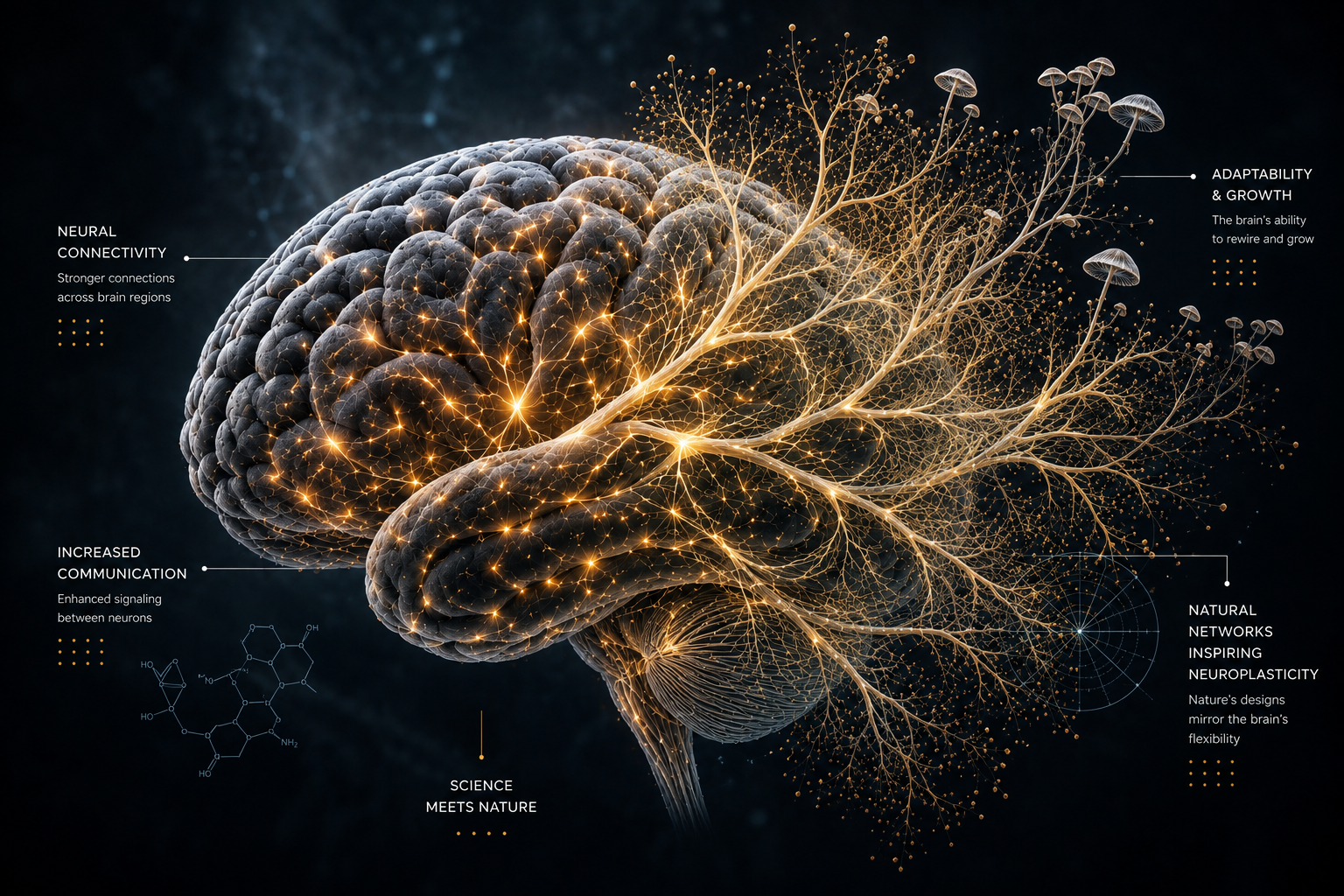
What if your brain is far less fixed than you were taught to believe?
For much of modern history, scientists viewed the adult brain as relatively stable. By the time we reached adulthood, many researchers believed the brain’s core architecture was largely set in place. Learning was certainly possible, but the idea that the brain could meaningfully reorganize itself later in life was often viewed with skepticism.
Today, we know that assumption was wrong.
The brain is constantly changing.
Every conversation, habit, skill, memory, challenge, and experience leaves a mark. New connections form. Existing pathways strengthen. Others weaken. Throughout life, the brain continuously adapts to the world around it.
Scientists call this process neuroplasticity.
And over the last decade, one of the most intriguing areas of psychedelic research has centered on a simple but profound question:
Can psilocybin influence the brain’s ability to change?
Increasingly, researchers believe the answer may be yes.
That possibility has helped transform psychedelic science from a niche field of study into one of the most closely watched areas of modern neuroscience.
The implications extend far beyond psychedelics themselves.
Because if the brain is more adaptable than we once believed, it changes how we think about memory, learning, recovery, behavior, aging, and human potential itself.
What Is Neuroplasticity?
At its simplest, neuroplasticity refers to the brain’s ability to adapt and reorganize itself.
Every time you learn a new skill, practice a language, recover from an injury, build a habit, or change a long-standing behavior, neuroplasticity is at work.
The brain isn’t a static machine.
It’s a living network.
Billions of neurons communicate through trillions of connections. These connections constantly strengthen, weaken, reorganize, and evolve based on how they’re used.
This adaptability helps explain why children learn so quickly, why stroke patients can sometimes regain lost abilities, why new habits can replace old ones, and why recovery remains possible long after injury.
One of the most important discoveries in modern neuroscience is that change doesn’t stop when childhood ends.
The adult brain remains remarkably dynamic.
While plasticity may slow with age, it never disappears entirely.
That’s important because many of the conditions researchers study today—from depression and addiction to chronic pain and cognitive decline—involve patterns that become deeply established over time.
Neuroplasticity offers a framework for understanding how those patterns might change.
Why Psychedelic Researchers Became Interested
For years, scientists studying psychedelics noticed something unusual.
Many participants reported lasting changes following a single experience.
Not just temporary shifts in perception.
Lasting changes.
People described breaking long-standing habits, adopting new perspectives, improving relationships, reducing rumination, and experiencing greater psychological flexibility.
Some participants reported changes that persisted for months.
Occasionally, even years.
Researchers naturally began asking why.
How could an experience lasting only a few hours create changes that seemed to extend far beyond the experience itself?
One possible explanation involved neuroplasticity.
Over the last decade, laboratory studies have suggested that psychedelic compounds may temporarily increase the brain’s capacity for adaptation. Researchers have observed changes associated with increased neural connectivity, enhanced communication between brain networks, and growth in structures involved in learning and memory.
While scientists are still working to understand exactly how these mechanisms operate, the findings have helped fuel a growing interest in how psilocybin influences the brain’s ability to reorganize itself.
The “Brain Rewiring” Narrative
You’ve probably heard someone say that psilocybin “rewires the brain.”
It’s a phrase that appears everywhere—from podcasts and documentaries to social media posts and headlines.
And while the phrase isn’t entirely wrong, it can be misleading.
Researchers aren’t suggesting that psilocybin completely rebuilds the brain overnight.
The reality is more nuanced.
When scientists talk about neuroplasticity, they’re describing a state in which the brain may become more flexible and receptive to change.
Think of it less like rebuilding a house and more like opening roads that were previously difficult to access.
Patterns that normally feel automatic may become easier to examine.
Connections that rarely communicate may begin interacting.
New possibilities may emerge.
The brain doesn’t become a different brain.
But it may temporarily become a more adaptable one.
And adaptability is often where meaningful change begins.
Why Connectivity Matters
One of the most fascinating findings in psychedelic research involves communication between different regions of the brain.
Under ordinary circumstances, the brain operates through specialized networks that perform specific functions. Some influence memory. Others shape attention, emotional processing, self-reflection, or sensory perception.
Psilocybin appears to temporarily alter how these networks communicate.
Researchers have observed increased connectivity between regions that don’t normally interact as extensively.
Imagine a city where neighborhoods that rarely communicate suddenly open direct lines of connection.
Information moves differently.
New perspectives emerge.
Rigid patterns become less dominant.
Many scientists believe this increased communication may help explain some of the profound psychological and cognitive shifts reported during psychedelic experiences.
The implications are still being explored.
But they may help explain why neuroplasticity has become one of the most important concepts in modern psychedelic science.
Neuroplasticity and Memory
One reason neuroplasticity has attracted so much attention is its relationship to memory.
Most people think of memory as storage. Information goes in, information comes out.
Neuroscience paints a more complicated picture.
Remembering requires communication between multiple brain systems. Attention, emotion, language, recognition, and context all work together to create what we experience as memory. Rather than existing in a single location, memories emerge from networks communicating across the brain.
That’s one reason researchers have become increasingly interested in how psilocybin influences connectivity.
If communication between networks changes, what happens to memory?
Scientists don’t yet have definitive answers. But the question gained significant attention following a widely discussed Alzheimer’s case report involving an elderly woman who experienced temporary improvements in communication, emotional expression, and memory recall following a psilocybin experience.
Importantly, researchers did not describe the outcome as a cure.
The underlying disease remained.
Yet the case raised a fascinating possibility: what if some cognitive functions are not entirely gone, but simply more difficult to access?
That question remains unanswered.
But it highlights why neuroplasticity has become such an important area of research.
Neuroplasticity and Movement
Memory isn’t the only area where neuroplasticity may matter.
Movement depends on communication between multiple brain networks and the body itself. Walking, balancing, speaking, reaching, and coordinating all require countless signals moving through the nervous system every second.
Researchers are increasingly exploring whether enhanced neural flexibility could help explain reports of unexpected changes in movement following psychedelic experiences.
Stories like that of Kacia Julius have attracted attention because they challenge assumptions about how movement is controlled and how recovery occurs. While these stories do not establish scientific proof, they raise important questions about brain-body communication and the role adaptability may play in physical function.
If movement relies on communication, what happens when communication changes?
Scientists are still working to answer that question.
But neuroplasticity sits at the center of the conversation.
Neuroplasticity and Chronic Pain
Pain offers another powerful example of why neuroplasticity matters.
Most people think of pain as something that happens in the body.
In reality, pain is also deeply neurological.
The brain continuously interprets signals coming from muscles, joints, organs, and nerves. It decides which sensations deserve attention, how intensely they should be experienced, and how the body should respond.
This is one reason chronic pain can be so difficult to understand.
Sometimes the original injury heals.
The pain remains.
Researchers increasingly believe that changes within the nervous system itself may help explain why.
This has led scientists to explore whether neuroplasticity plays a role in how pain patterns develop, persist, and potentially change over time.
While research involving psilocybin and chronic pain remains ongoing, many investigators believe neuroplasticity may ultimately help explain some of the effects reported in both clinical studies and patient experiences.
Why Aging Doesn’t Mean the End of Change
Perhaps one of the most exciting implications of neuroplasticity involves aging.
For much of modern history, aging was viewed primarily through the lens of decline. Memory declines. Learning slows. Adaptability decreases.
While certain cognitive changes do occur with age, neuroscience has increasingly challenged the idea that the aging brain becomes fixed.
Research now shows that the brain remains capable of adaptation throughout life.
People continue learning new skills.
New connections continue forming.
Neural networks continue changing.
The rate of change may differ from person to person, but the capacity for change never completely disappears.
This shift in understanding has profound implications for how we think about learning, resilience, cognitive health, and human potential.
And it’s one reason psychedelic researchers have become increasingly interested in how compounds like psilocybin influence adaptability later in life.
Why This Matters Beyond Psychedelics
The story of neuroplasticity is ultimately much bigger than psilocybin.
It’s a story about human adaptability.
For decades, many conditions were viewed through the lens of permanence. Depression. Trauma. Addiction. Chronic pain. Cognitive decline.
Today, neuroscience increasingly emphasizes change.
The brain can learn.
The brain can adapt.
The brain can reorganize.
And in many cases, it can continue doing so throughout life.
This doesn’t mean every challenge can be overcome through neuroplasticity alone. Nor does it mean every claim surrounding psychedelics is supported by evidence.
But it does suggest that the human brain may be more flexible than we once imagined.
And that’s an exciting idea.
Because if change remains possible, then so does growth.
The Bottom Line
Scientists are still working to understand exactly how psilocybin influences the brain.
Many questions remain unanswered.
But one theme continues appearing throughout the research:
Adaptability.
Psilocybin appears to influence systems involved in learning, communication, flexibility, and change. Researchers increasingly believe these effects may be connected to neuroplasticity - the brain’s remarkable ability to reorganize itself throughout life.
The most exciting thing about neuroplasticity isn’t that it promises easy answers.
It’s that it challenges old assumptions.
For years, we viewed the brain as fixed.
Today, we’re beginning to understand that change may be one of its defining characteristics.
That realization affects how we think about memory.
Movement.
Pain.
Recovery.
Aging.
And ultimately, human potential itself.
The future of psychedelic science may not depend on discovering something entirely new.
It may depend on helping us better understand something that has been there all along:
The brain’s extraordinary capacity to adapt.
Continue Exploring
· Psilocybin Beyond Mental Health: What Scientists Are Learning About the Brain, Body, and Human Potential
· Can Psilocybin Help Unlock Lost Memories? The Alzheimer’s Story Raising New Questions
· Explore EDEN’s Mushroom Collection
Frequently Asked Questions
What is neuroplasticity?
Neuroplasticity is the brain’s ability to adapt, reorganize, and form new neural connections throughout life.
Does psilocybin rewire the brain?
Researchers do not believe psilocybin completely rewires the brain overnight. However, studies suggest it may temporarily increase neural flexibility and communication between brain networks.
Why are scientists interested in neuroplasticity?
Neuroplasticity plays a central role in learning, memory, recovery, adaptation, and behavior change.
What is brain connectivity?
Brain connectivity refers to how different regions of the brain communicate and exchange information


