

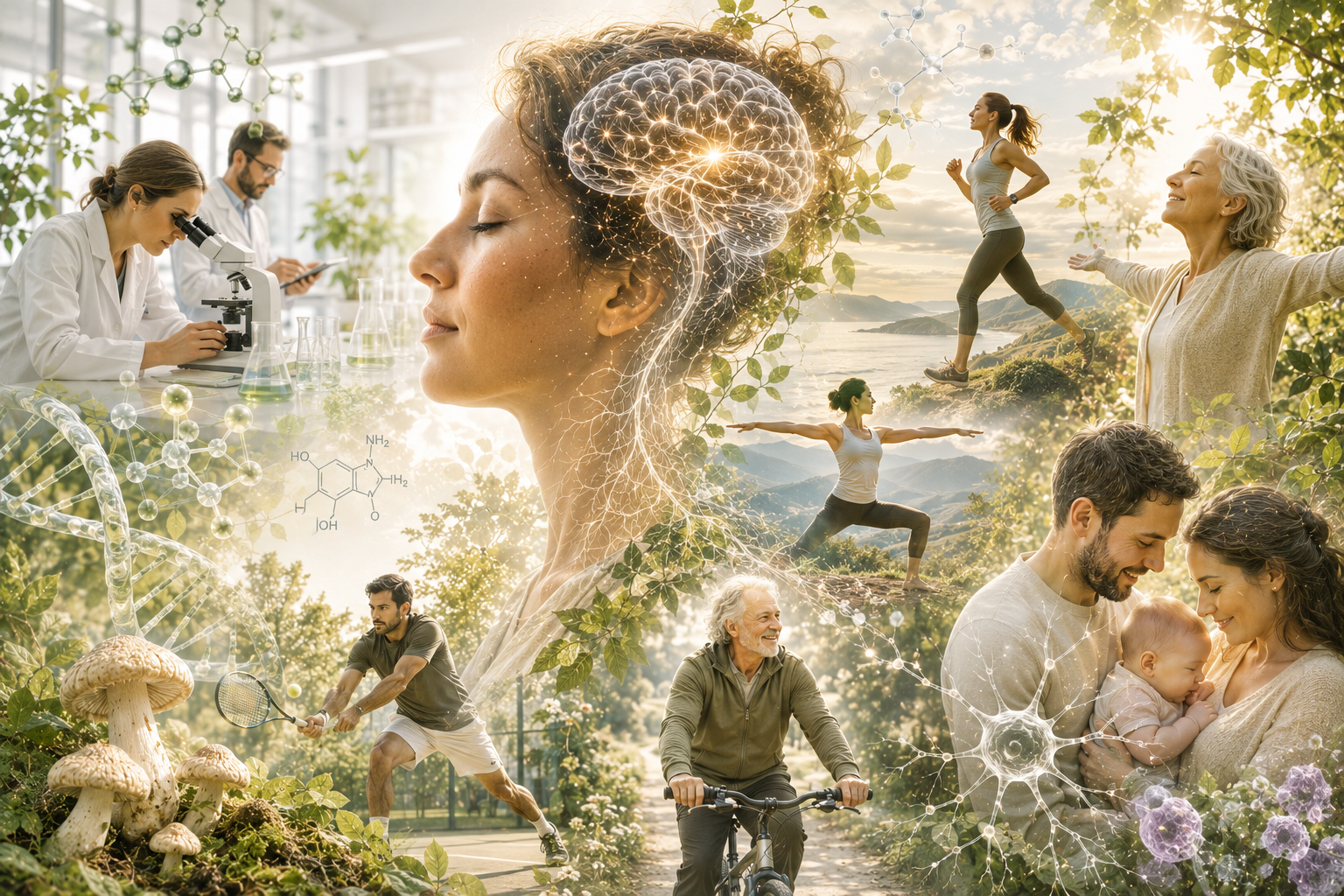
For years, nearly every conversation about psilocybin revolved around mental health.
Depression.
Anxiety.
PTSD.
Addiction.
And for good reason. Some of the most promising psychedelic research of the past decade has focused on helping people navigate emotional suffering and improve psychological well-being.
But something interesting is happening.
As researchers continue studying psilocybin, they're beginning to ask much bigger questions. Not just whether it can influence mood, but whether it may affect some of the fundamental systems that help humans learn, adapt, recover, and change.
How does the brain form new pathways?
Can perception influence movement?
What role does neuroplasticity play in memory, pain, aging, and resilience?
The answers remain far from settled. Yet the scope of the questions is expanding rapidly.
Today's psychedelic research is no longer focused exclusively on mental health. Increasingly, scientists are exploring how psilocybin may interact with some of the deepest mechanisms involved in human adaptation itself.
The Shift From Mental Health to Neuroplasticity
If there is one word driving the next generation of psychedelic research, it's neuroplasticity.
Neuroplasticity refers to the brain's ability to adapt, reorganize, and form new connections throughout life. For decades, scientists believed the adult brain was largely fixed. Today, we know the opposite is true.
The brain is constantly changing in response to learning, habits, experiences, injury, environment, and age. Every skill we develop, every memory we form, and every behavior we repeat leaves its mark on the neural pathways that shape our lives.
This is one reason psilocybin has captured so much scientific interest.
Research suggests psilocybin may temporarily increase communication between different regions of the brain while loosening some of the rigid patterns that influence how we think, feel, and perceive the world. Scientists continue to investigate exactly how these mechanisms work, but the implications are difficult to ignore.
For years, much of the conversation centered on mental health. Today, researchers are exploring a broader possibility: that psilocybin's effects on neuroplasticity may have implications that extend far beyond mood alone.
That single question sits at the center of nearly every emerging area of psychedelic science.
Why Adaptability Matters
For much of modern medical history, many neurological conditions were viewed through the lens of decline.
If a function was lost, the assumption was often that it could not return.
Modern neuroscience is gradually challenging that idea.
Researchers now understand that the brain may be far more adaptable than previously believed. While there are still significant limits to what science knows, growing interest in neuroplasticity reflects a larger shift in thinking: the possibility that the brain remains capable of learning, adapting, and reorganizing throughout much more of life than once assumed.
This shift has implications that extend well beyond mental health.
It influences how scientists think about memory, recovery, movement, aging, and resilience itself.
Memory, Learning, and Cognitive Function
One of the most fascinating areas of emerging research involves memory.
Recently, researchers documented a widely discussed case involving an elderly woman living with advanced Alzheimer's disease who experienced temporary improvements in communication, emotional expression, and memory recall following a psilocybin experience.
Importantly, researchers did not describe the outcome as a cure. The disease remained.
Yet the observations raised an intriguing question:
Could certain neurological functions become more accessible under specific conditions, even when they appear diminished?
No one knows the answer yet.
However, studies examining neuroplasticity, cognitive flexibility, and brain connectivity continue to generate interest in how psychedelic compounds may interact with memory systems.
As populations age and cognitive decline becomes an increasingly important public health challenge, this remains one of the most closely watched areas of psychedelic science.
Related Reading: Can Psilocybin Help Unlock Lost Memories? The Alzheimer's Story Raising New Questions
The Brain-Body Connection
Most people think of movement as something physical.
In reality, every movement begins in the brain.
Every step, gesture, and muscle contraction depends on communication between the nervous system and the body. When those communication pathways become disrupted, symptoms can emerge that are often far more complex than simple structural damage alone.
Researchers are increasingly interested in understanding how perception, neuroplasticity, and nervous system regulation influence movement itself.
Stories have emerged of individuals reporting unexpected changes in mobility following psychedelic experiences. These accounts should not be viewed as evidence of treatment or recovery, but they raise important questions about how the brain controls, restricts, and potentially restores movement.
If future research confirms meaningful connections, it could reshape how scientists think about adaptation, rehabilitation, and recovery.
Chronic Pain: More Than a Physical Sensation
Pain is often thought of as a physical problem.
But pain is also deeply neurological.
The brain constantly interprets signals from the body, deciding what deserves attention and how intensely sensations should be experienced.
This is one reason chronic pain has become such an intriguing area of psychedelic research.
Scientists are increasingly exploring whether psilocybin may influence the networks involved in pain perception, emotional processing, and self-awareness.
The most interesting question isn't simply whether psilocybin affects pain.
It's whether it changes how the brain experiences pain.
That distinction could have profound implications for understanding long-term suffering and quality of life.
Inflammation and the Immune System
For years, inflammation was viewed primarily through a physical health lens.
Today, researchers understand that chronic inflammation may influence a remarkably wide range of processes throughout the body, including those connected to mental and neurological well-being.
While research remains in its early stages, scientists are beginning to explore whether psychedelic compounds interact with inflammatory pathways and immune system signaling.
This doesn't mean psilocybin should be viewed as an anti-inflammatory treatment.
Rather, it reflects a growing realization that the nervous system and immune system may be far more interconnected than previously believed.
Understanding those connections could eventually reveal entirely new dimensions of how psychedelic compounds influence human biology.
Brain Injury, Recovery, and Rehabilitation
Another area attracting growing scientific interest is recovery after neurological injury.
Whether caused by trauma, stroke, or other neurological events, recovery often depends on the brain's ability to create new pathways and compensate for damaged ones.
Because neuroplasticity appears to play such a central role in these processes, researchers have become increasingly interested in understanding whether psychedelic compounds may have relevance within future rehabilitation frameworks.
This remains an emerging field.
No conclusions have been reached.
Yet the possibility that psychedelic compounds could one day contribute to adaptive neurological processes continues to attract serious scientific attention.
Why Cluster Headaches Captured Researchers' Attention
Long before psychedelics entered mainstream conversations, people living with cluster headaches were already talking about them.
Often described as one of the most painful conditions known in medicine, cluster headaches have generated decades of patient reports describing unexpected experiences following psilocybin use.
Over time, the consistency of these reports attracted the attention of researchers.
Today, cluster headaches remain one of the most frequently discussed neurological conditions in psychedelic science.
It's a reminder that scientific discovery often begins with observations from real people searching for answers long before formal research catches up.
Aging, Resilience, and the Future of Brain Health
Perhaps the most compelling question of all is also the broadest:
How does the brain maintain adaptability as we age?
For much of modern history, aging was viewed primarily through the lens of decline.
Today, researchers increasingly focus on resilience.
What helps the brain remain flexible?
What supports learning later in life?
What preserves curiosity, adaptability, and cognitive function?
Because neuroplasticity sits at the center of these questions, psychedelic research has naturally become part of the conversation.
The goal isn't immortality.
It's understanding how the brain continues learning, adapting, and evolving throughout the human lifespan.
A New Way of Thinking About Psilocybin
Perhaps the biggest shift happening in psychedelic science is this:
Researchers are moving beyond the question of whether psilocybin affects depression or anxiety.
Instead, they're asking a much larger question:
How does psilocybin influence the brain's capacity to adapt?
That single question connects nearly every emerging area of research.
Memory.
Movement.
Pain.
Inflammation.
Recovery.
Aging.
Each represents a different expression of the same underlying process:
The ability to change.
And while many of the answers remain unknown, the questions themselves are reshaping how scientists think about the relationship between the brain, the body, and human potential.
The Bottom Line
Psilocybin is not a cure-all.
Many of the questions researchers are asking today remain unanswered. Some areas of investigation may ultimately lead nowhere. Others could fundamentally reshape how we understand adaptation, learning, recovery, and resilience.
What's clear is that the conversation has moved beyond mood alone.
Scientists are now exploring how psilocybin interacts with some of the most fundamental systems involved in change itself.
The most exciting thing about modern psychedelic science isn't that we've found all the answers. It's that we're finally beginning to ask better questions.
As interest in psychedelic science continues to grow, education remains one of the most valuable tools available to consumers. Whether you're researching neuroplasticity, learning about microdosing, or comparing different mushroom strains, understanding the fundamentals can help you navigate this rapidly evolving field with greater confidence. To continue your exploration, you can browse our mushroom collection and educational resources for additional information on psilocybin products, strains, and emerging research.
Continue Exploring
Psychedelic science is evolving rapidly, and many of the most interesting questions are only beginning to be explored. If you'd like to dive deeper into specific areas of research, these are a great place to continue:
Live now:
Frequently Asked Questions
Is psilocybin only being studied for mental health?
No. While much of the research has focused on depression, anxiety, PTSD, and addiction, scientists are increasingly exploring how psilocybin may influence neuroplasticity, memory, movement, pain perception, inflammation, recovery, and aging.
What is neuroplasticity?
Neuroplasticity is the brain's ability to adapt, form new connections, and reorganize throughout life. It plays a critical role in learning, memory, recovery, and behavioral change.
Can psilocybin increase neuroplasticity?
Emerging research suggests psilocybin may influence mechanisms associated with increased brain connectivity and neuroplasticity. Researchers continue studying how these processes work.
Can psilocybin improve memory?
Scientists are actively studying how psilocybin affects memory and cognition. However, there is currently no evidence that psilocybin cures memory disorders such as Alzheimer's disease.
Why are researchers interested in psilocybin and chronic pain?
Researchers are exploring whether psilocybin may influence the way the brain interprets and responds to pain signals, potentially affecting the experience of chronic pain.
What are cluster headaches?
Cluster headaches are considered one of the most painful neurological conditions. Patient reports have encouraged researchers to investigate whether psychedelic compounds influence the biological pathways involved.
Is psilocybin a cure-all?
No. Psilocybin is not a cure-all, and many areas of research remain preliminary. The most exciting aspect of modern psychedelic science is the emergence of new questions about how the brain adapts, learns, and recovers.


